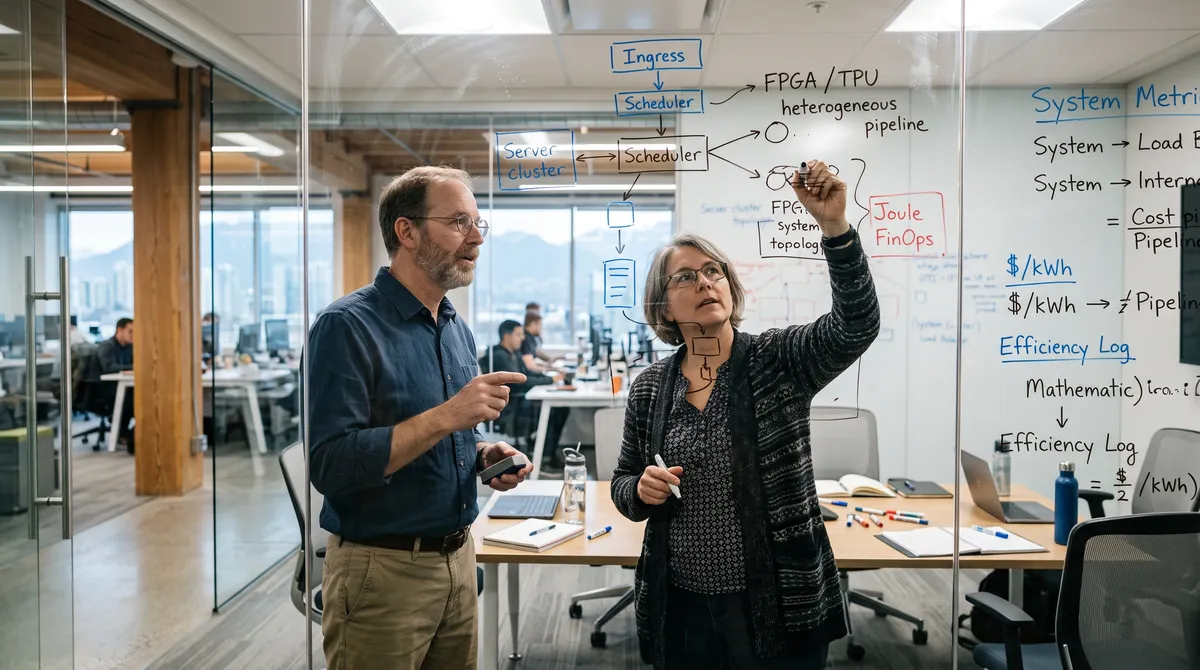
Systems engineering and IT infrastructure operations across Canada and the global tech ecosystem are undergoing a fundamental recalibration. Driven by severe data center power grid constraints and interconnect physical limitations, engineering teams are abandoning naive cloud scaling strategies in favor of maximizing computational throughput per Watt.
Concurrently, software architecture teams across Toronto, Vancouver, and Montreal are standardizing how autonomous AI agents interface with internal backend systems while interactive media studios decouple monolithic game engine editor pipelines into modular, WebAssembly-based runtimes. Benchmark telemetry from Gartner and the DORA (DevOps Research and Assessment) report confirms a decisive pivot away from unconstrained delivery speed toward operational predictability, controlled context exposure, and strict FinOps accountability.
1. Data Center Power Constraints Force Transition to Heterogeneous Compute Architectures
Power capacity limits across major data center hubs in Ontario and Quebec have transformed energy consumption from a facility management detail into a primary software architecture constraint. Facing strict utility grid caps and peak demand surcharges, engineering organizations can no longer rely on continuously scaling unoptimized compute instances.
In response, infrastructure teams are re-architecting critical workloads toward heterogeneous compute models. Instead of running heavy inference and data ingestion routines on general-purpose x86 servers or underutilized GPU instances, organizations are building custom co-designed hardware/software pipelines leveraging specialized ARM chips and dedicated acceleration silicon.
- Kernel and Runtime Optimization: Backend teams are rewriting latency-sensitive microservices in C++20 and Rust, deploying them on specialized inference runtimes (such as vLLM and TensorRT-LLM) to achieve up to 40% reductions in memory footprint and electrical draw per request.
- Edge Data Sanitization: To avoid streaming massive raw datasets back to central cloud data centers, engineering architectures are deploying localized edge nodes to perform preliminary filtering and vector embedding transformations closer to the data source.
- Joule-Based FinOps Metrics: Observability dashboards now track financial expenditure directly mapped to energy metrics (Joules per API transaction), establishing energy efficiency as a core metric for code deployment approval.
2. Enterprise Adoption of Model Context Protocol (MCP) Standardizes Agentic Tool Integration
The widespread adoption of Anthropic’s Model Context Protocol (MCP) across enterprise software development teams in Ontario and British Columbia has established a unified interface standard for AI agent tool integration. Rather than writing custom, fragile API wrappers for every internal database, telemetry system, and code repository, engineering teams are deploying standardized MCP servers to expose backend capabilities safely to autonomous agents.
While MCP simplifies tool discovery and context passing, production telemetry indicates that unconstrained agentic execution loops still introduce subtle memory leaks, unindexed queries, and race conditions under heavy traffic loads.
To counter these systemic liabilities, technical leads are overhauling integration pipelines with strict execution guardrails:
- Standardized Tool Interfaces: Backend systems expose database schemas, log aggregators, and git workflows through typed MCP server endpoints, allowing AI agents to query system context without direct access to raw database drivers or internal credentials.
- Deterministic Wasm and Container Sandboxing: Automated coding agents are restricted to running generated scripts inside short-lived WebAssembly (Wasm) runtimes or isolated Docker containers with hard limits on CPU, memory, and outbound network socket creation.
- Granular OpenTelemetry Agent Tracing: DevOps teams are implementing custom OpenTelemetry instrumentation to monitor agent decision trees, tracing every tool invocation, prompt token consumption metric, and recursive sub-task invocation in real time.
3. Interactive Media Studios Shift to Decoupled Wasm Build Toolchains and Modular Engines
Following structural updates to provincial media funding mechanisms and a broader market consolidation across AAA operations, interactive entertainment studios in Quebec, Ontario, and British Columbia are redirecting capital into decoupled toolchain automation. Studios with 30 to 120 employees are phasing out heavy monolithic editor pipelines in favor of modular, microservice-based asset processing pipelines executed inside lightweight WebAssembly runtimes.
Rather than forcing technical artists and developers to run manual asset compilation inside heavy GUI instances of Unreal Engine 5 or Unity, engineering teams are building decoupled build pipelines that run headlessly in continuous integration environments.
- Headless Wasm Asset Processing: Technical artists are using C++20 and Rust compiled to WebAssembly runtimes inside containerized CI environments to automate LOD (Level of Detail) generation, texture baking, and mesh optimization asynchronously.
- Low-Level Systems Engineering: Recruitment priorities have shifted toward systems programmers capable of writing native C++20 engine extensions, custom memory allocators, and high-performance Rust build scripts that interface directly with custom asset pipelines.
- Distributed Build Caching: Production pipelines are leveraging distributed build systems (such as FastBuild and IncrediBuild) coupled with localized NVMe storage caching nodes to minimize full-project recompilation times during multi-platform builds.
Strategic Questions for Engineering Leadership
Maintaining operational stability in the current environment demands deep technical rigor, strict infrastructure control, and deterministic automation. Organizations must balance the speed of automated tools with strict pipeline evaluation gates, local inference management, and efficient build pipelines.
How is your technical leadership team adapting its infrastructure architecture, CI/CD evaluation gates, and asset compilation pipelines to meet these operational realities this quarter?