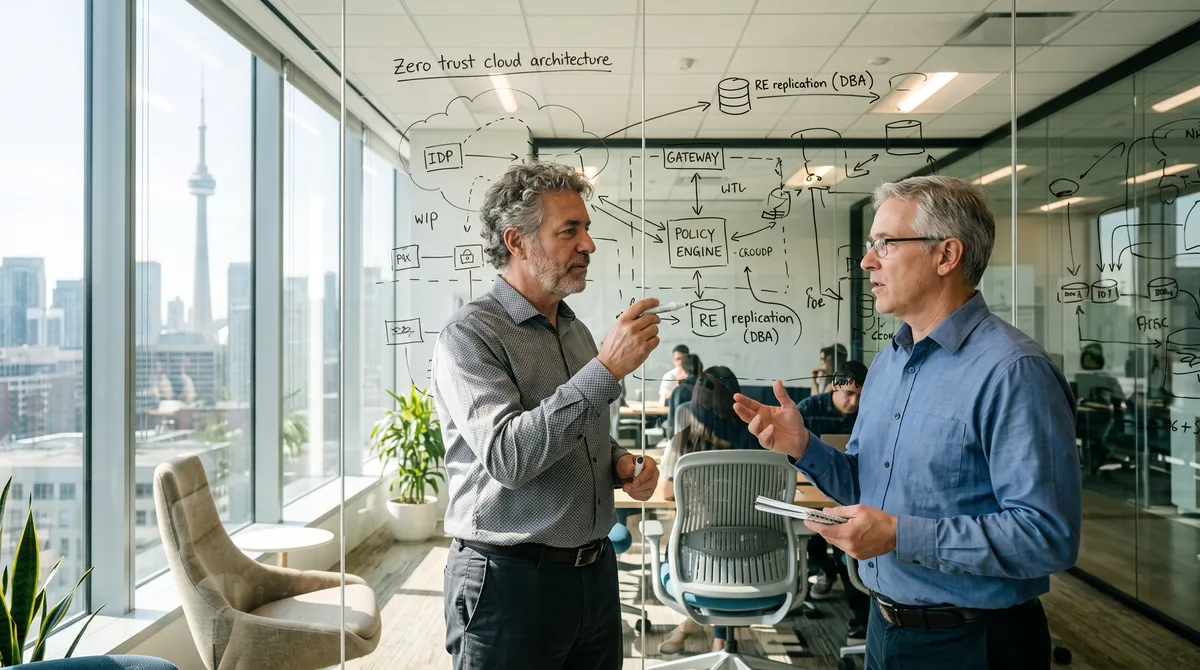
The Canadian technology sector has entered a consolidation phase governed by capital efficiency, regulatory enforcement, and strict operational auditing. Following years of rapid headcount expansion and speculative cloud migration, engineering organizations across Toronto, Vancouver, and Montreal are reassessing system architectures to reduce operational overhead and maintain regulatory compliance.
According to data from recent industry benchmarks—including the DORA (DevOps Research and Assessment) report and Gartner’s enterprise infrastructure analysis—organizations are shifting focus from software delivery velocity to long-term system stability, data sovereignty, and cloud cost governance (FinOps).
1. Statutory Data Residency Laws Reshape Canadian Cloud Architecture
The enforcement of Quebec’s Law 25 alongside updated federal PIPEDA (Personal Information Protection and Electronic Documents Act) mandates has transformed data residency from a legal compliance checklist into an architectural bottleneck. Canadian enterprises operating in healthcare, financial technology, and public-sector integrations can no longer rely on cross-border data transit to U.S.-East availability zones without explicit, multi-layered end-to-end encryption and verified local storage guarantees.
While major cloud providers continue to scale physical footprints in the Canada Central (Montreal) and Canada West (Calgary) availability zones, backend engineering teams bear the operational burden of decoupling legacy multi-region deployments.
- Database Partitioning and Physical Residency: Engineering teams are actively migrating monolithic databases to geographically partitioned PostgreSQL and MongoDB instances. Data access layers are programmatically constrained to ensure user tables containing Personally Identifiable Information (PII) remain physically stored on servers located within Canadian borders.
- Zero-Trust Edge Sanitization: Inbound API traffic is routed through localized API gateways (such as Kong or AWS API Gateway edge deployments in Montreal) that strip, tokenize, or encrypt sensitive payload fields before routing non-sensitive operational telemetry to global analytical services.
- Automated Policy-as-Code Enforcement: Continuous Integration pipelines now embed automated Infrastructure-as-Code (IaC) compliance scanners using Open Policy Agent (OPA) or Checkov. Any Terraform or Pulumi pull request attempting to provision storage buckets or compute nodes outside verified Canadian region codes is automatically blocked at the build stage.
For cloud architects and principal engineers, compliance is no longer managed through quarterly legal audits. It is maintained programmatically through deployment pipelines, driving steady demand for professionals skilled in zero-trust networking and policy-as-code automation.
2. Unverified AI Code Generation Increases Long-Term Technical Debt in Enterprise Production
The initial productivity gains associated with generative AI coding assistants have reached a plateau in enterprise environments. While code generation volume increased across major development hubs in Toronto and Vancouver, production telemetry over recent quarters indicates a sharp rise in downstream maintenance overhead and architectural degradation.
Data from recent software quality assessments reveals that code snippets generated by large language models frequently pass basic unit tests while introducing subtle concurrency flaws, unindexed database queries, and resource leaks that surface only under heavy traffic loads.
To mitigate these production risks, engineering directors are restructuring code review workflows and deployment gatekeeping mechanisms:
- Mandatory Memory and Concurrency Profiling: Organizations are updating CI/CD pipelines to require automated memory leak detection and thread-concurrency profiling (using tools like Valgrind, pprof, or SonarQube Enterprise) on all auto-generated or AI-assisted pull requests before staging clearance.
- Shift in Pull Request Evaluation: Senior developers are reallocating code review time from syntax validation to deep architectural auditing, thread safety verification, and resource deallocation logic.
- Strict PR Line-Count Limits: Engineering organizations are capping automated refactoring pull requests to a maximum of 200 lines of modified code per review, ensuring human reviewers can thoroughly trace execution paths and edge-case handling.
In 2026, engineering productivity metrics are moving away from raw commit frequency and lines of code produced. Evaluation frameworks now emphasize mean time to recovery (MTTR), service uptime, and the reduction of post-deployment defect rates.
3. Quebec’s Tax Credit Realignment Accelerates Toolchain Automation in Interactive Media
Quebec’s provincial government has updated the framework for the Multimedia Title Tax Credit (CTMM), narrowing eligible labor expenditures to focus directly on core software engineering, engine development, and technical pipeline automation. Administrative and non-technical roles receive reduced subsidy coverage, forcing game development studios in Montreal and Quebec City to restructure production operations.
This regulatory adjustment, combined with broader market consolidation in the interactive entertainment sector, has accelerated the transition away from bloated production teams toward lean, highly technical studios. Rather than maintaining costly legacy proprietary engines or relying entirely on uncustomized commercial middleware, studios are investing in internal toolchain automation to lower long-term licensing costs and streamline content pipelines.
- Low-Level Systems Specialization: Studio recruitment has pivoted toward C++ and Rust engineers capable of developing custom engine plugins, optimizing memory management, and refining real-time rendering pipelines in Unreal Engine 5 and open-source frameworks like Godot.
- Pipeline Automation Engineering: Technical artists and pipeline engineers who build automated asset validation scripts, continuous integration builds, and automated QA testing frameworks are seeing sustained demand across mid-sized studios (20 to 60 employees).
- Decoupled Architecture: Production pipelines are moving away from monolithic engine setups toward modular, micro-service-oriented asset processing tools that allow rapid iteration without full engine recompilation.
For developers in the interactive media space, technical proficiency in low-level systems programming and build automation has become the primary defense against industry volatility.
Strategic Summary for Engineering Leaders
Navigating the Canadian technology sector in 2026 requires strict adherence to engineering fundamentals over superficial velocity metrics. Success is defined by building compliant, local data architectures, enforcing rigorous quality gates on automated code generation, and optimizing build pipelines for lean operational execution.
How is your organization adapting its infrastructure architecture, code review protocols, and FinOps practices to meet these compliance and operational requirements this year?